The main objective of teaching anatomy is to study the structural principles of tissues, organs, and systems of a healthy human body.
The primary tasks of anatomy are aimed at a comprehensive study of the embryonic and post-embryonic development of human tissues, organs, and systems, their macroscopic and microscopic structure, laws of vital activity, individual and age-related changes, sex characteristics, as well as the influence of the external environment and labor on the body. This includes consideration of changes during prenatal development (ontogenesis), topographic relationships, radiological anatomy, developmental variability (congenital anomalies), and age-related features.
The following requirements are set for students’ knowledge and skills:
A student should know:
- types of tissues and organs, their general structure and functions;
- sources of organ development, timing of formation, structural foundations, functions, and age-related changes;
- stages of tissue and organ development, their characteristics, systems, and critical periods of embryogenesis;
- general biological principles of tissue and organ integration;
- structure and function of tissues and organs for understanding pathological changes.
In studying operative surgery and topographic anatomy, the main focus is on individual and age-related variability of organs and systems, their normal features, and changes under pathological conditions. The discipline also includes information about surgical interventions. Depending on surgical objectives, the microscopic structure of organs and anatomical formations is described, including the histotopography of vessels and nerves. The body’s response to surgical interventions is also considered.
Modern pedagogical technologies are applied in teaching the discipline. The aim of the subject in training general practitioners is to present anatomical knowledge relevant to surgical practice in both normal and clinical conditions. The goal is to provide future physicians with the knowledge and skills necessary for accurate diagnosis and rational selection of surgical treatment methods.
The following requirements are set for students’ knowledge and skills:
A student should know:
- external and internal landmarks and boundaries of regions;
- layered structure of anatomical regions;
- projections of major blood vessels and nerve trunks;
- holotopy, syntopy, and skeletotopy of internal organs;
- typological features of organs, their structural variations, blood supply, and innervation;
- changes in organ topography in common pathological conditions;
- collateral circulation pathways;
- lymphatic drainage from specific regions or organs;
- location of fascial and cellular spaces and pathways of spread of infections and hematomas;
- fascial compartment structure of limbs;
- typological features of the skull and face, their variations, blood supply, and innervation;
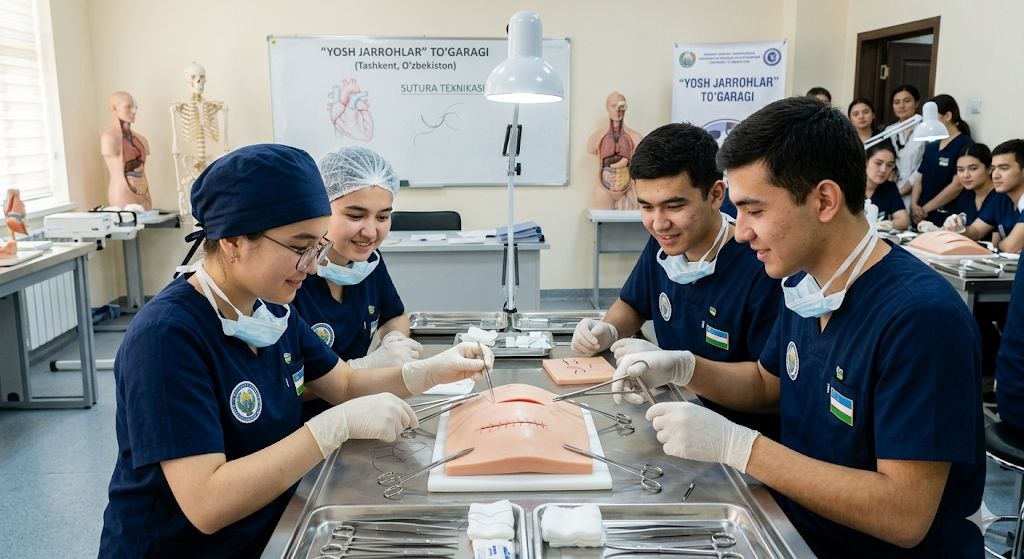
- modern surgical instruments, sutures, and materials;
- patient positioning on the operating table;
- indications, contraindications, and postoperative complications;
- surgical approaches and techniques of the most common operations;
- modern microsurgical and minimally invasive techniques (endoscopic, endovideosurgery), as well as operations using laser, ultrasound, cryo-, and electrosurgical methods.